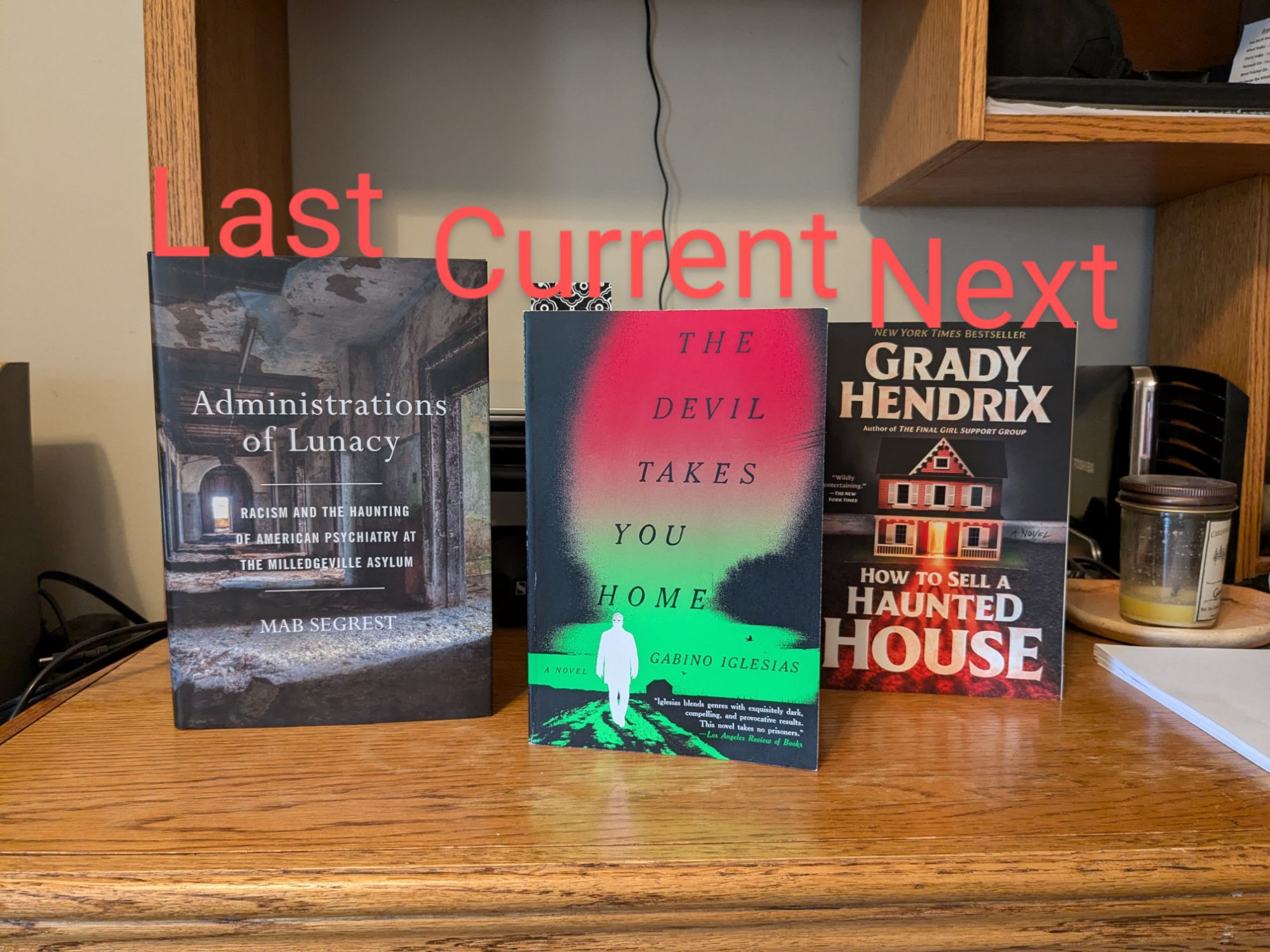
Administrations of Lunacy by Mab Segrest
I feel like I’ve said enough about this book. Finishing it felt like an accomplishment. While I think that the book deals with Important Stuff, which may be more pertinent than ever, it was hard to get through because my brain is wired to read stories.
During those chapters that we got to know the inmates and administrators, I found the book much easier to read. When the author delved into an itemized list of produced food and goods by the hospital, which got assimilated into the post-slavery concept of prison farms and prison labor, my brain was set adrift without a character to anchor itself. Yes, it’s Important, but hard to engage with, at least for me.
It did make me want to reread Eutopia by David Nickle.
-\-
The Devil Takes You Home by Gabino Iglesius
The name of Gabino Iglesius has come to my attention several times in the last couple of years. This is the first book of his that I’m reading and I’m about 200 pages in.
This is the kind of horror story I want to write these days. The story is steeped in the kind of real world social injustices that plague our country, from our healthcare system to our border crisis to cartel violence and racial violence. The story addresses these concerns through the character of Mario, who has lost his daughter to cancer, is buried under the mountain of debt her unsuccessful treatment accumulated, and whose wife leaves him in the aftermath.
As a sidenote, I can’t imagine a worse situation than needing to continue to pay for healthcare that was unsuccessful.
In true American mythological fashion, Mario latches onto the idea that money will solve his debt crisis (it will) and win Melisa back (it probably won’t). This sets up the kind of “one last job” story that run deep in the western and crime thriller genres.
Along the way, weird stuff starts happening. I won’t get into that because that’s where the meat of the story is. I’m enjoying it for the most part.
I say, for the most part because of two things: the story is written in first person limited perspective, which I feel is an old chestnut by now; also, because several of the characters speak Spanish, they do so. While I have no problem with this, I wonder what I’m not getting by not understanding Spanish. Please note, I know I could use Google Translate or some similar app to translate the text, but I decided that that would be too disruptive to my reading, so I have opted not to do so. When reading the Spanish dialogue, I just try to float my eyes over the words and look for the words I do know or can puzzle out. Most of the time there are context clues to the dialogue by which I get the gist. But it’s something a reader should probably know going in.
-\-
How to Sell a Haunted House by Grady Hendrix
Grady Hendrix is another name that I keep coming across. I thought that Horrorstor would be my first. I’ve picked it up on several trips to bookstores, but have always put it back for some reason.
I finally decided to pick up How to Sell a Haunted House based on the blurbs on the back cover, describing it as “[a] madcap fun house of a novel” (Riley Sager) and “authentically frightening, genuinely funny” (Esquire).
As I’ve written about my love of humor as well as horror, I’m looking forward to reading a story that can blend the two.

 The Chimerical Dark