Station Eleven by Emily St. John Mandel (not pictured)
I’m probably write more about the broader subject in a separate post, but this book is a prime example of A Story and B Story.
This book took me longer than expected to read, especially given the increased pace at which I read my last few books. It started off strong, with a solid A Story that, now that we’ve lived through a recent global pandemic, felt uncomfortably familiar. Kirsten roams the land with a group known as The Traveling Symphony, performing Shakespeare and classical music to post-apocalyptic towns.
What I liked about the premise, aside from being a theatre guy, was the tagline written on one of the caravans of the Symphony: “Survival is not sufficient.” While I think that the breakdown of society will be chaotic and messy (like the early months of the Covid pandemic), humans survived for tens of thousands of years not through rugged individualism and general assholery, but through cooperation, and the earliest records were people figuring out how to chew plants to make ink to spit at a cave wall in order to have visual representation of their adventures.
I’m probably the most optimistic cynic you’ll ever meet.
The conflict comes early, when the Symphony happens upon a town they’ve been through before, but which has been taken over by a character known only as the Prophet. The Prophet is really no different from any real-world person who uses religion for self-aggrandizement and manipulation. However, there is a thread that connects Kirsten and the Prophet, though both are unaware of it.
It’s this thread that’s explored in the B Story, and it’s here that my interest in the story waned. I just didn’t find the B Story as interesting as the A Story. It’s a story of personal drama whose timeline starts long before the Georgia Flu pandemic. While poignant at times, especially as the timeline catches up with the outbreak of the pandemic, it didn’t hold my interest as much.
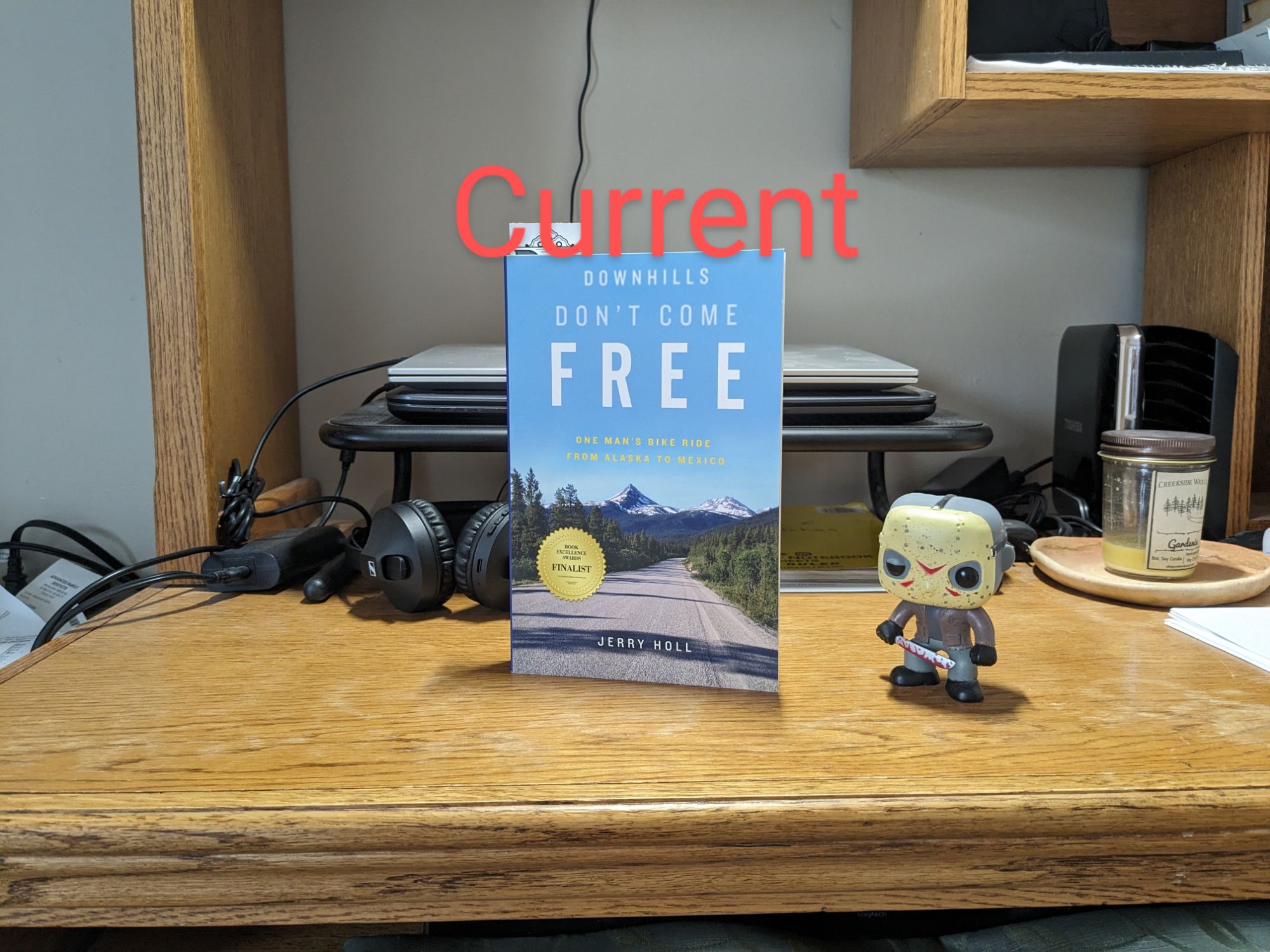
Downhills Don’t Come Free by Jerry Holl
“How long do you think this journey will take you?”
“I have no idea. I don’t know the total distance or what my sustainable pace can be. Bigger yet, since I’ve never done anything like this, I don’t know if my body, mind, or bike will break down. So, I don’t know what to expect or what I’ll run into–with all that, my wild-ass guess is four or five months.”
I think that the author’s response to the innkeeper’s question at the end of his first day encapsulates the hubris and privilege of the typical middle-aged white man that makes me want to reach through the pages and just slap the shit out of him.
Obviously, he survived, which takes a little bit of an edge off of the story (which is the same reason I don’t invest as much into stories written in first person). To, the author’s credit, he acknowledges his privilege of his life’s circumstances. However, my co-worker in the bike shop told me that the book would infuriate me, and so far, he’s not wrong.
I get it and I tell people all the time, who I train to work on bikes: “There are a million things that can go wrong on a bike. I can’t train you to know and have the answer to those million things. But I can train you to recognize and fix the 3 dozen common ways a bike can break down. The rest will come with time and experience.” So, when planning a huge adventure, like biking from Alaska to Mexico, you can’t plan for everything and, at a certain point, you just have to go and trust that your knowledge and experience can be adapted to new circumstances and be enough to see you through.
But the author just has blind faith in himself based on nothing.
I’d be lying if I said that I’m not reading this book for some schadenfreude, to laugh at the stupid decisions and shake my head at things that I know that the author doesn’t (or didn’t). But I am also reading it as an educational piece. So far (about 40 pages in), his hubris and naivety, while infuriating, is also engaging. So at least there’s that.
What’s next (not pictured)
I’ve got 6 books in my Bookshop cart, but I haven’t placed the order yet. Since I don’t know what’s next, I’m going to plug them.
From their website’s About section:
Bookshop.org works to connect readers with independent booksellers all over the world.
We believe local bookstores are essential community hubs that foster culture, curiosity, and a love of reading, and we’re committed to helping them thrive.
Every purchase on the site financially supports independent bookstores. Our platform gives independent bookstores tools to compete online and financial support to help them maintain their presence in local communities.
I encourage you to take advantage and shop local, even when shopping online.
What are you reading?
Since I’m still up in the air as to what’s next on my TBR, let me know what you’re reading and what you like about it.

 The Chimerical Dark